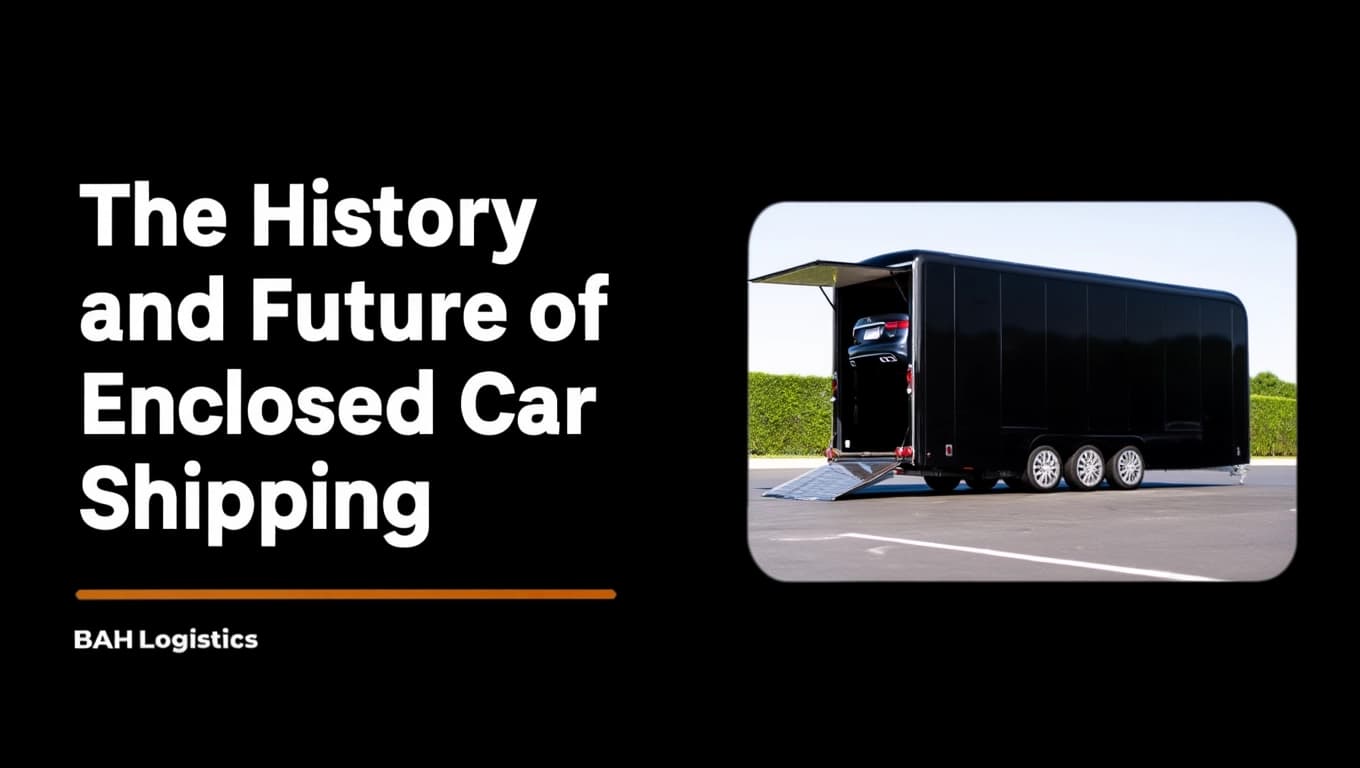

Although we are all accustomed to enclosed transport today, there was a time when such convenient transportation didn’t exist. Today, the global enclosed car shipping market is projected to reach $3.5 billion by 2035, indicating that it has become an integral part of our lives. From its humble beginnings with railroad boxcars to today’s climate-controlled trailers, each advancement has responded to evolving customer needs and technological breakthroughs. Let’s take a closer look at the history of enclosed car transport and explore its future direction.
The Early Days: Shipping Cars by Boxcar
Since the 1830s, boxcars have served as the primary means of transporting protected freight across America. Their fully enclosed design shielded goods from weather and theft, and over time, they were adapted to carry everything from paper and appliances to food products.
The Baltimore & Ohio Railroad developed the first practical boxcar prototype, a wooden enclosure featuring a roof, side doors, and end-loading access. This innovation marked a pivotal moment in railroad history, enabling efficient and protected transport of valuable goods across long distances.
The transition to automotive transport came in 1906, when the Pere Marquette and New Haven railroads built the first boxcars specifically designed for vehicles, according to the Oklahoma Railway Museum. The first semi-trailer, considered a prototype of modern trailers, was constructed by August Fruehauf in 1914 to haul a boat behind a Ford Model T. These early auto boxcars laid the foundation for what would become the enclosed car shipping industry.
The Shift to Enclosed Truck Transport (1950s–1980s)
The turning point in enclosed vehicle transport came during the period from the 1950s to the 1980s. While open car carrier trailers dominated highway transport of new vehicles, the most significant innovations in enclosed transport were happening on the railroads. In the 1950s, double-decker trailers with hydraulic ramps and adjustable decks could transport up to ten vehicles simultaneously; however, vehicles remained vulnerable to weather, road debris, vandalism, and theft.
In the mid-1950s, Volkswagen engineers collaborated with German railroads to design a two-level flatcar system, demonstrating the viability of multi-level vehicle transport. In 1973, the first enclosed autorack prototype, called the "Snap-Pak," was developed through a collaboration between Norfolk & Western Railway, Whitehead & Kales, and Ford Motor Company to protect vehicles from theft and vandalism during rail transport.
By the mid-1980s, roofs were added to most autoracks, and by the late 1980s, end doors were introduced, completing the fully enclosed autoracks that became the industry standard and remain common today.
Modernization and High-Tech Innovation (1990s–Present)
The 1990s marked a period of innovation for enclosed car trailers, driven by advances in materials, design, and technology. Trailer manufacturers began offering both hard-sided and soft-sided options to meet different market needs. Hard-sided trailers provided maximum protection for luxury and exotic vehicles, while soft-sided models offered a lighter, more affordable alternative for standard transportation.
Companies like Wells Cargo, Pace, and Car Mate led the industry forward, producing trailers equipped with rear swing doors, side access doors, and sophisticated internal tie-down systems. Construction materials evolved, aluminum trailers offered weight savings and corrosion resistance, while steel provided maximum durability for heavy-duty applications.
The 2000s and 2010s brought true high-tech transformation. GPS tracking systems became standard, allowing real-time monitoring of vehicle location and shipment status. Climate control systems emerged to protect sensitive vehicles from temperature extremes. Advanced suspension systems reduced road vibration and impact damage during transport.
Today's enclosed trailers represent the pinnacle of this evolution, incorporating hydraulic lift gates, integrated security systems, and even remote monitoring capabilities. The combination of advanced technology and premium service has transformed enclosed car shipping from a basic transportation method into a luxury concierge experience. Many trailers from the 1990s remain in service, a testament to the durability and thoughtful engineering of that era, while newer models continue pushing the boundaries of vehicle protection technology.
The Future of Enclosed Car Shipping
The future of enclosed car transport is being shaped by technology, transforming trailers into intelligent, connected assets capable of unprecedented levels of protection and efficiency.
Adapting to Electric and Autonomous Vehicles
The rise of electric vehicles has introduced new transport protocols. EV batteries are maintained between 20% and 80% charge during shipping to minimize fire risk, while their low ground clearance and heavy battery packs require specialized loading equipment and tie-down systems. As autonomous vehicles enter the market, enclosed trailers are being equipped with the power and connectivity needed to maintain these complex systems during transit.
AI-Powered Route Optimization
Artificial intelligence is revolutionizing route planning for enclosed transport. Machine learning algorithms analyze real-time traffic, weather conditions, road quality, and even bridge weight limits to dynamically optimize routes. This results in safer journeys, fewer delays, and reduced fuel consumption. Smart trailers equipped with IoT sensors continuously monitor internal conditions—temperature, humidity, movement, and tire pressure—sending real-time alerts to drivers and customers if anything falls outside safe parameters.
Sustainable Innovation
Environmental responsibility is driving material innovation. Advanced aluminum alloys and carbon fiber composites create lighter trailers that improve fuel efficiency without sacrificing strength. Some manufacturers are testing solar panels integrated into trailer roofs to power monitoring systems and climate control. Electric-assist trailer systems use onboard motors to reduce the load on towing vehicles during acceleration and uphill climbs. Combined with optimized load planning and consolidated shipping routes, these innovations are steadily reducing the carbon footprint of enclosed car transport.
Looking Forward
As the automotive industry rapidly evolves toward electrification, autonomy, and connectivity, enclosed car shipping will evolve alongside it. The trailers of tomorrow will offer not just physical protection, but complete digital oversight, ensuring that whether transporting a vintage collectible or a cutting-edge autonomous EV, every vehicle arrives in perfect condition with a complete digital record of its journey.
What This Means for Vehicle Owners
For vehicle owners, the evolution of enclosed transport brings tangible benefits in safety, transparency, and customization:
Enhanced safety and monitoring. Modern trailer innovations significantly enhance safety by minimizing human error through real-time monitoring, GPS tracking, and active assistance systems. Vehicle owners now have unprecedented visibility into their car's journey from pickup to delivery.
Premium protection is becoming standard. What was once considered luxury car shipping is increasingly becoming standard protection. Advanced technology—from climate control to hydraulic lift gates—is now widely available across the industry, making premium enclosed transport accessible to more customers than ever before.
Advanced technology will lead the market. Innovation in enclosed transport is shaping the industry, and BAH Logistics is at the cutting edge of this transformation. We maintain a carefully curated network of carriers equipped with the latest enclosed trailer technology. Your vehicle is transported in modern trailers featuring advanced safety systems, climate control, and hydraulic lift gates, providing premium protection at competitive rates.
The Path Forward in Enclosed Transport Evolution
The enclosed trailer industry has undergone a remarkable transformation, from humble railroad boxcars in the 1830s to today's intelligent, climate-controlled trailers equipped with real-time monitoring and AI-powered systems. The future of enclosed transport promises even more, pushing the boundaries of innovation to ensure safer, more efficient, and more reliable vehicle shipping as we enter an exciting new chapter in its evolution.
Contact BAH Logistics to experience the advantages of modern enclosed car transport. Whether you’re transporting a classic car or a cutting-edge electric vehicle, our company combines technology, expertise, and trusted carriers to deliver premium protection every step of the way.




