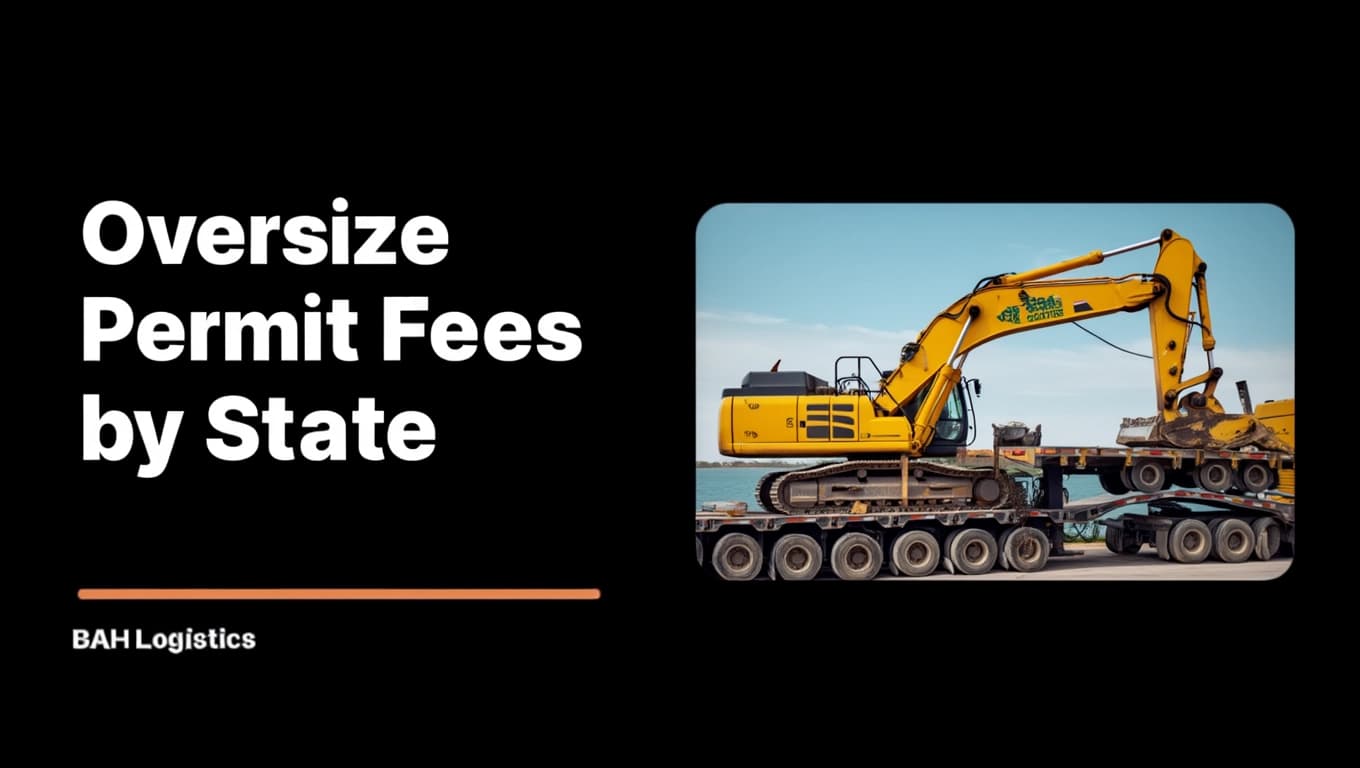

You've decided to move your oversize load, but what's it actually going to cost in permits? Fees can range from $15 to more than $200 per state, and that's before excess weight charges, escort vehicle requirements, or route restrictions come into play. Because every state sets its own rules, crossing a border unprepared can lead to delays, fines, or costly disruptions. This guide from BAH Logistics breaks down oversize and overweight permit fees by state, explains permit requirements, and shares practical tips to help you avoid surprises and plan your route with confidence.
What Is an Oversize or Overweight Permit?
An oversize or overweight permit is a legal authorization required whenever a shipment exceeds standard federal or state size and weight limits on public roads. While exact thresholds vary by state, the typical legal limits are:
Width: 8 feet 6 inches (8.5 feet)
Height: 13 feet 6 inches (14 feet in many Western states)
Length: 53-foot trailer length
Weight: 80,000 lbs gross vehicle weight
Loads that exceed dimensional limits generally require an oversize permit, while loads that exceed legal weight limits require an overweight permit. These permits are issued by each state's Department of Transportation (DOT) or permitting authority, meaning a cross-country shipment typically requires a separate permit for every state it travels through.
Depending on the route, additional permits may also be required from counties, cities, or other local jurisdictions, particularly in major metropolitan areas. For most shipments, carriers use a single-trip permit, which authorizes one specific move along a pre-approved route. The permit fees listed in this guide reflect standard single-trip permits.
Permit fees are only one part of the total cost. Additional expenses may include pilot cars (escort vehicles), route surveys, utility coordination, law enforcement escorts, and other special requirements, all of which vary significantly by state.
States Issue Oversized Permits in 2 Ways
How a permit is issued can be almost as important as the permit fee itself. While most states now accept electronic permits (e-permits), others still require drivers to carry a physical paper copy in the cab. Understanding the difference can help you avoid delays and compliance issues.
States That Accept Electronic Permits (e-Permits)
Most states now allow drivers to display oversize permits digitally on a smartphone, tablet, or laptop. Electronic permits typically offer faster processing and can often be issued instantly or on the same day.
States that accept e-permits include Alabama, Arkansas, California, Colorado, Connecticut, Florida, Iowa, Idaho, Kentucky, Louisiana, Maine, Maryland, Michigan, Minnesota, Mississippi, Missouri, Montana, Nebraska, Nevada, New Hampshire, New Mexico, North Carolina, North Dakota, Oregon, South Dakota, Georgia, Tennessee, Utah, Vermont, West Virginia, and Washington (single-trip permits only; conditions apply).
Why this matters: Electronic permits simplify compliance, reduce paperwork, and help carriers get on the road faster.
Always download the permit directly to your device. In areas with limited or no cellular service, a cloud-stored permit may be inaccessible during an inspection. Virginia is a special case and requires both an electronic permit and a paper copy.
States That Recommend or Require Paper Permits
Some states still require a physical permit to be carried in the vehicle during transport. In certain cases, permits may be mailed or require additional processing steps. States that require or strongly recommend paper permits include Alaska, Delaware, Kansas, Massachusetts, New Jersey, New York, Oklahoma, Pennsylvania, Rhode Island, South Carolina, Texas (paper copy strongly recommended), and Wisconsin (except for certain no-cost farm permits).
Why this matters: Paper permit requirements can add processing time and create delays if documentation is not prepared before departure.
Oversize Permit Fees by State: Full Breakdown
Permit fees vary more than most carriers expect, from as little as $8 in Alaska to over $500 for superloads in Georgia or Vermont. The table below reflects single-trip fees unless noted otherwise. Always verify current rates with your state's DOT before booking.
States Requiring Paper Permit
| State | Single-Trip Fee | Annual/Multi-Trip | Paper or Electronic | Notes |
|---|---|---|---|---|
| Alaska | $8–$50+ | N/A | Paper | Must show a permit regardless of the service area. |
| Delaware | $10 minimum | N/A | Paper | $5 per 8,000 lbs overweight; $11 flat fee per toll road. |
| Hawaii | N/A | N/A | Paper | Hawaii does not connect to the continental highway network. |
| Kansas | $20 | $150–$2,000 | Paper | State law requires paper; some officers may accept electronic. |
| Massachusetts | $40 | $400 | Paper | Superload fee $300; stricter limits on I-90. |
| New Jersey | $10–$20 base + surcharges | $100 | Paper | $5/ton over 80,000 lbs; 12% service charge added. |
| Oklahoma | $40 base + $10/1,000 lbs | $240/year (triples) | Paper | Special Movement fee $500 for newly manufactured items. |
| Pennsylvania | $36 | N/A | Paper | Overweight adds $0.04/ton-mile. |
| Rhode Island | $20 | $100 | Paper | Electronic permits under consideration. |
| South Carolina | $30–$50 | $100 | Paper | Superload engineering analysis up to $350. |
| Wisconsin | $15–$105+ | $200–$1,050 | Paper | Farmers may show no-cost permits electronically. |
States Requiring Electronic Permit
| State | Single-Trip Fee | Annual/Multi-Trip | Paper or Electronic | Notes |
|---|---|---|---|---|
| Alabama | $10–$110 | $100 | Electronic | Fee varies by weight and dimension combination. |
| Arizona | $15–$75 | N/A | Electronic | $1/axle/50 miles for registration; $15 Class A overdimensional. |
| Arkansas | $17 base + mileage surcharge | N/A | Electronic | Additional per-ton fee based on distance traveled. |
| California | $16 | $90 | Electronic | RCATZ/STARS2 only for e-permits. |
| Colorado | $15–$50+ | $250–$3,000+ | Electronic | $5/axle added for overweight; surcharge doubles base fee. |
| Connecticut | $23 + $3 transmission fee | $7/1,000 lbs | Electronic | Annual fee based on gross weight. |
| Florida | $5–$25 | $20–$500 | Electronic | Blanket permits must be paper; overweight charges per mile. |
| Georgia | $30–$500 | $150–$500 | Electronic | Superload/Mega Load approval can take 3–30 days. |
| Idaho | $28–$128 | $43–$53 | Electronic | Fuel/temp registration permits must be paper. |
| Illinois | $12–$125+ | N/A | Electronic | Paper required if police escort is needed. |
| Indiana | $20–$30 base + mileage | $405 | Electronic | Paper required if police escort is needed. |
| Iowa | $10 | $25–$300 | Electronic | One of the lowest single-trip fees in the country. |
| Kentucky | $60 | $80–$500 | Electronic | Annual fee varies by width and load type. |
| Louisiana | $10/day or $10/trip | $500 | Electronic | When overweight, only overweight fees are assessed. |
| Virginia | $20 + $0.30/mile (overweight) | $100–$560 | Both Required | Both paper and electronic copies must be carried simultaneously. |
Key takeaways:
Oregon and Iowa have the lowest single-trip fees ($8–$10)
Vermont and Georgia can run into hundreds or thousands for superloads
Virginia is the only state requiring both paper and electronic records simultaneously
Texas fees can reach $435+ once highway maintenance fees are added
Fees above are base rates for escort vehicles; bridge analysis and routing fees are separate
Tips for Managing Oversized Permit Costs Across States
Permit fees are only one part of the total cost of moving an oversize load. Escort vehicles, route restrictions, processing delays, and local permit requirements can quickly increase your expenses. These practical strategies can help keep your project on budget.
Compare Routes Before Shipping. Permit fees and escort requirements vary significantly from state to state. In some cases, a slightly longer route can be less expensive overall if it avoids high permit costs or additional pilot car requirements. Always compare multiple route options before finalizing your shipment plan.
Apply Early. Many oversize loads can be permitted quickly, but superloads and overweight shipments often require engineering reviews, bridge analyses, or additional approvals. Applying early helps avoid rush fees, delays, and costly downtime.
Confirm Whether the Load Is Truly Non-Divisible. Most states only issue oversize or overweight permits for non-divisible loads. If a shipment can reasonably be separated into smaller legal loads, a permit may be denied. Verify eligibility before investing time and money in the permitting process.
Don't Forget Local Permits. State permits typically apply only to state-maintained highways. Cities, counties, ports, and other local jurisdictions may require separate permits for portions of your route. Overlooking these requirements can lead to delays and fines.
Check Travel Restrictions. Many states restrict oversize travel during weekends, holidays, peak traffic periods, or adverse weather conditions. Reviewing travel restrictions before scheduling your move can help prevent unexpected delays and idle equipment costs.
Verify All Dimensions and Axle Weights. Accurate measurements are critical. Incorrect dimensions, axle spacings, or weight information can invalidate a permit, resulting in fines, route changes, permit revisions, or additional application fees. Double-check all load specifications before submitting permit applications.
Work With an Experienced Oversize Transport Provider. Managing permits across multiple states can be time-consuming and complex. Experienced shipping companies like BAH Logistics understand state-specific requirements, permitting timelines, and route restrictions, helping avoid costly mistakes while keeping shipments compliant and on schedule.
BAH Logistics Navigates Oversized Permit Costs with Confidence
Oversize permitting is one of the most complex aspects of heavy-haul transportation, and even small mistakes can lead to costly delays, fines, and scheduling disruptions. Understanding permit fees, state-specific requirements, and route restrictions is essential for keeping your shipment compliant and on schedule. At BAH Logistics, we help customers navigate every step of the oversize transport process. Whether you're moving a single piece of heavy equipment or coordinating a multi-state heavy-haul project, BAH Logistics has the experience and resources to get the job done safely and efficiently. Ready to move your oversize load? Contact BAH Logistics today for a free, no-obligation quote.
FAQs on Oversize Permit Fees
How long does it take to get an oversize permit?
Most routine oversize permits can be issued the same day through state permitting systems. However, superloads, overweight shipments, bridge reviews, and complex multi-state routes often require additional review and can take anywhere from several days to several weeks.
Can I get permits for multiple states at once?
In some cases, yes. Several states participate in the Western Association of State Highway and Transportation Officials (WASHTO) permitting system, which allows carriers to apply for permits across participating states through a single platform. However, many states still require separate applications and approvals. For interstate shipments, BAH Logistics coordinates all required permits to simplify the process and avoid delays.
What happens if I transport an oversize load without a permit?
Moving an oversize or overweight load without the required permits can result in substantial fines, roadside inspections, forced stops, route restrictions, and shipment delays. In serious cases, authorities may prohibit the load from moving until proper permits are obtained. The cost of compliance is almost always far lower than the cost of a permit violation.
Do oversize permit fees change?
Yes. Permit fees are established by each state's Department of Transportation (DOT) or other permitting authority and may be updated periodically. While some states maintain the same fee structure for years, others adjust rates following legislative or regulatory changes.
Who is responsible for obtaining oversize permits?
In most situations, the carrier is legally responsible for securing the permits required to transport the load. However, shippers play an important role by providing accurate dimensions, weights, axle configurations, and route information. At BAH Logistics, we work closely with both customers and carriers to ensure all permit requirements are met before transport begins.
Are escort vehicles included in oversize permit fees?
No. Permit fees generally cover only the authorization to operate an oversize or overweight load on public roads. Escort vehicles, police escorts, route surveys, utility coordination, and other special requirements are typically separate costs. Requirements vary by state and are often based on the load's dimensions and route.
Do I need local permits in addition to state permits?
Sometimes. State permits generally apply only to state-maintained highways. Depending on your route, additional permits may be required from cities, counties, ports, or other local jurisdictions. Failing to obtain local permits can lead to delays, fines, or route restrictions.




