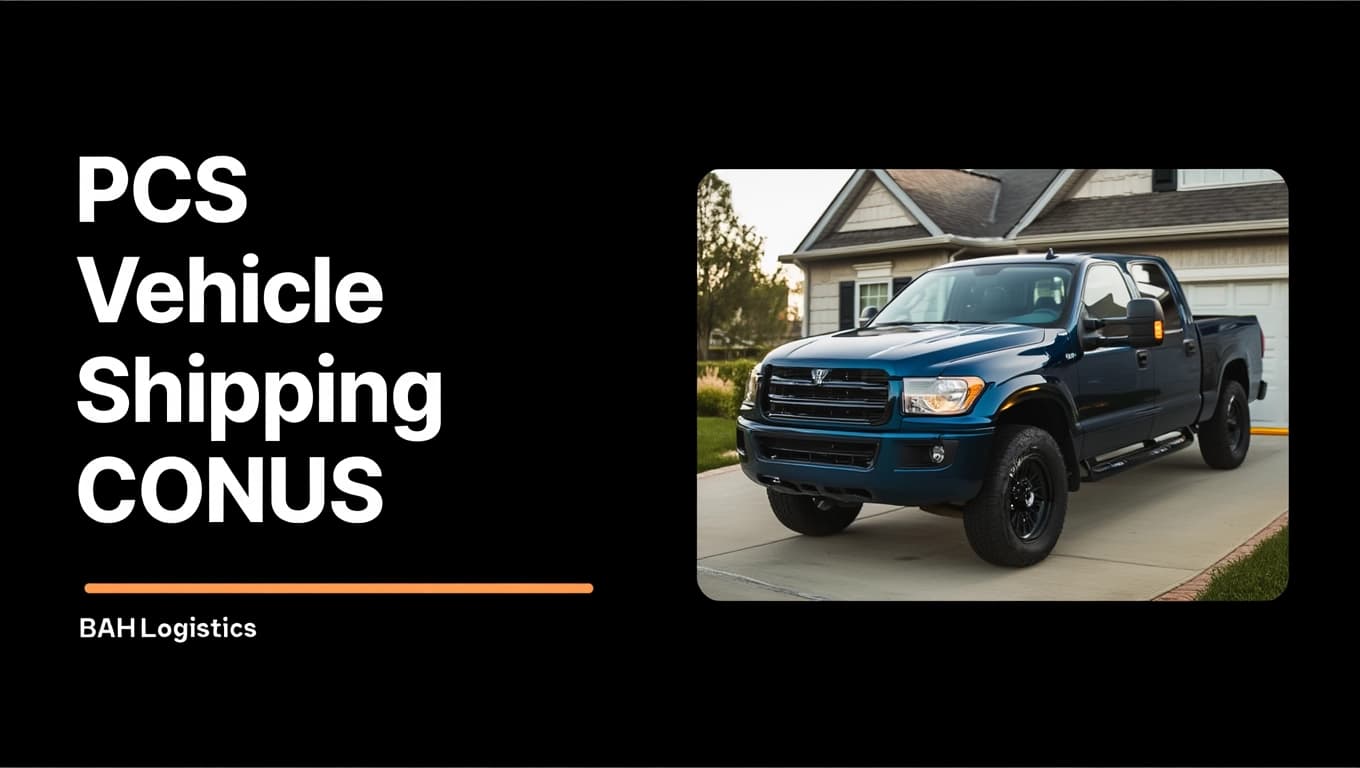

Receiving PCS orders sets an entire relocation in motion at once. Household goods get inventoried, reporting dates get confirmed, and somewhere in that process, every service member faces the same practical question: what happens to the car?
For moves within the continental United States (CONUS), the military typically does not cover POV shipping, except in limited or special cases. That means many service members choose to move their car with an auto transport expert like BAH Logistics.
At BAH Logistics, we work with active duty service members, military families, and veterans through every stage of vehicle relocation. As an FMCSA-registered carrier operating across all 50 states, with a DOT-verified track record and up to $1,000,000 in insurance coverage on every move, we have handled enough PCS shipments to know exactly where the process goes smoothly and exactly where it does not.
This guide covers every step of CONUS vehicle shipping, including required documents, timelines, and situations where the government covers the full cost.
What Is POV Shipping and Who Qualifies?
POV stands for privately owned vehicle. It refers to any motor vehicle (car, truck, or motorcycle) owned or long-term leased by a service member or their dependent, rather than the government.
Who Qualifies?
Active Duty: All branches (Army, Navy, Air Force, Marine Corps, Coast Guard, and Space Force).
Requirement: The shipment must be specifically authorized in your PCS orders.
Reserve & National Guard: Eligibility depends on the specific nature of the orders (usually active-duty tours of a certain length). These members should verify with their local Transportation Office.
OCONUS vs. CONUS
OCONUS (Overseas): Shipping is standard for moves to or from OCONUS locations (like Germany, Japan, or Hawaii) because driving isn't an option. The government pays for one vehicle to be shipped via a Global Privately Owned Vehicle Contract (GPC) processing center.
CONUS (Domestic): Shipping a vehicle within the 48 contiguous states at government expense is rare. You are expected to drive the vehicle and receive a Mileage Allowance instead of Transportation (MALT). For long-distance moves or added convenience, many choose to hire a professional auto transport company to handle the shipment.
When is CONUS Shipping Covered?
The government may authorize CONUS-to-CONUS shipping in specific cases, such as:
Medical Issues: If the service member or a dependent is physically unable to drive.
Short Reporting Time: When the time between your detachment and report date is too short to realistically drive the distance.
Separation/Retiree Travel: In some cases involving medical retirement or specific separation programs.
Shipyard/Remote Assignments: When moving to a location with extreme geographic constraints.
Two-Vehicle Families. If your family owns two vehicles and has two licensed drivers, you may qualify for partial reimbursement to ship the second vehicle while the family drives the first.
Step by Step: How CONUS POV Shipping Works
The CONUS POV shipping process follows a clear sequence from verifying eligibility to final vehicle pickup at your destination.
1. Verify Entitlements & Confirm Orders
Start by reviewing your PCS orders and contacting your local Transportation Office to determine whether POV shipping is authorized or if you must arrange private transport. In most CONUS-to-CONUS moves, service members are responsible for arranging their own vehicle shipment.
2. Prepare Documentation
Gather all required paperwork, including your vehicle title (or lienholder authorization if applicable), registration, and valid military identification.
3. Choose Your Transport Option
If using government services where authorized, you will schedule delivery through the official POV shipping system and drop off your vehicle at a designated Vehicle Processing Center (VPC). If shipping privately, select a licensed car shipping company like BAH Logistics registered with the Federal Motor Carrier Safety Administration (FMCSA).
4. Prepare Your Vehicle
Clean your vehicle inside and out, remove all personal belongings, and ensure the fuel tank is no more than 1/4 full. This helps ensure a safe and compliant inspection and transport process.
5. Inspection & Drop-Off
At the time of pickup, the driver will perform a detailed inspection of your vehicle with you present. Any existing scratches, dents, or damage will be documented on the Bill of Lading (BOL). Make sure to review and sign it before the vehicle is loaded.
6. Pickup at Destination
Upon delivery, you will complete a final inspection with the driver. Compare the vehicle’s condition with the original Bill of Lading and confirm everything is in the same condition before signing off and accepting the vehicle.
Required Documents
Shipping your vehicle within the continental United States (CONUS) is a straightforward process when working with a licensed transport coordinator like BAH Logistics. Unlike military VPC shipments, domestic transport requires only a few essential documents and minimal preparation.
To ensure a smooth pickup and delivery, please have the following ready:
- Valid photo ID (driver’s license or government-issued ID)
- Vehicle registration or title (to confirm ownership or authorization to ship)
- Signed Bill of Lading (provided by the carrier at pickup)
- Vehicle keys (a full set for the driver)
- If you are not present at pickup or delivery, you may assign a representative. In this case:
- A simple authorization letter is recommended
- The representative must have a valid photo ID
Vehicle Preparation Requirements
Vehicles that do not meet preparation standards may be delayed or refused by the carrier at pickup. Fuel level is the most common reason for rejection, so that should be addressed first.
Required vehicle condition at drop-off:
- Fuel tank at one-quarter full or less
- Interior cleaned and free of all personal items, food, debris, and loose equipment
- No items hanging from the rearview mirror
- Non-permanently installed navigation, audio, or video equipment removed
- Roof racks and cargo carriers removed unless permanently mounted
- Full set of keys provided, including ignition, trunk, and wheel locks
- Vehicle in safe operating condition, functioning brakes, no significant fluid leaks
- No windshield cracks that would affect safe operation
- Alarm system disabled or disconnected
For electric vehicles, owners should charge the battery to full capacity before drop-off and provide the charging cable and owner's manual. Remote app access should not be used during transit, as it depletes the battery while the vehicle is in the shipping queue.
CONUS POV Shipping Timeline: What to Expect
Transit times within the continental United States are significantly shorter than overseas shipments and depend on distance, route, and carrier availability.
Typical delivery timelines:
- Short distance: 1–3 days
- Medium distance: 3–7 days
- Cross-country: 7–10 days (may extend up to ~14 days during peak season)
Unlike military VPC shipping, CONUS transport is handled directly by carriers, which allows for faster scheduling and delivery.
PCS season runs from May through August and is the busiest time of the year for auto transport. During this period, carrier availability becomes limited, pricing may increase, and pickup windows can extend by a few days. Service members receiving summer orders are strongly encouraged to book their shipment as early as possible.
Because transit times are relatively short, most customers experience minimal disruption. However, for long-distance moves, it is still recommended to plan temporary transportation if needed during the shipping window.
How Much Does CONUS POV Shipping Cost?
One of the first questions service members ask is what private vehicle shipping actually costs. While exact pricing depends on distance, vehicle size, transport type, and time of year, here are general ballpark ranges:
- Short distance (under 500 miles): $300–$600
- Medium distance (500–1,500 miles): $600–$1,000
- Cross-country (1,500+ miles): $1,000–$1,500+
- Peak PCS season (May–August) typically adds 10–20% to these estimates due to high carrier demand. Booking early is the single most effective way to lock in better pricing and availability.
Open vs. Enclosed Transport: Which Should You Choose?
When booking auto transport, you will typically be offered two options:
Open transport loads your vehicle onto an open-air carrier alongside other vehicles. This is the most common and most affordable method. It is perfectly suitable for standard passenger vehicles and is what most service members use.
Enclosed transport places your vehicle inside a covered trailer, protecting it from weather and road debris. This option costs roughly 30–50% more than open transport and is recommended for classic cars, luxury vehicles, or any vehicle with significant sentimental or monetary value.
For the majority of CONUS PCS moves, open transport is the practical and cost-effective choice.
CONUS POV Shipping Preparation Checklist
Documents
- Valid government or state-issued photo ID
- Vehicle title or registration (proof of ownership)
- Booking confirmation or Bill of Lading (provided by the carrier/broker)
Vehicle Condition
- Fuel level at ¼ tank or less
- Vehicle must be clean enough for inspection (not necessarily detailed)
- Remove all personal items from the interior
- No loose items, toll tags, or hanging accessories
- Provide a full set of keys
- Disable or provide instructions for the alarm system
- Vehicle must be in operable condition (or note if inoperable in advance)
- No active fluid leaks
At Pickup (Origin)
- Be present (or assign a representative)
- Complete a full inspection with the driver
- Existing damage will be documented on the Bill of Lading (BOL)
- Review and sign the BOL before loading
If Someone Else Handles Pickup
- Provide a signed authorization letter
- Share contact details with the driver and broker
At Delivery (Destination)
- Be available for delivery, or assign a representative
- Perform a final inspection with the driver
- Compare the condition with the original Bill of Lading
- Document any new damage before signing
- Sign the delivery section only after confirming the condition
Plan and Know Your Options Before Orders Drop
If you’re PCSing and need to ship your POV within CONUS, working with a professional auto transport company can make the entire process significantly easier. Instead of navigating timelines, carrier availability, and delivery coordination on your own, an experienced logistics partner can manage the details for you and align the shipment with your PCS schedule.
At BAH Logistics, we specialize in military vehicle transport and understand the unique timing and requirements that come with CONUS moves. Our team helps service members coordinate pickup, manage documentation, and schedule delivery efficiently, ensuring your POV arrives safely and on time at your new duty station.
A trusted auto transport service not only saves time and reduces stress, but also provides peace of mind knowing your vehicle is handled by professionals who understand military relocations.
Frequently Asked Questions on Military Shipping CONUS
When is CONUS POV shipping authorized?
CONUS vehicle shipping may be authorized in certain situations, including when a service member is assigned to a ship that is changing home port, when there is a documented medical condition that prevents the service member or a dependent from driving, or when there is insufficient time to safely complete the drive between duty stations. All cases must be reviewed and approved by your command and coordinated through your local Transportation Office.
What if I cannot drive my vehicle?
If you are unable to drive your vehicle, there may still be options available depending on your circumstances. For example, if you own more than one vehicle, are married, and your dependents are relocating with you, you may qualify for reimbursement or additional support. Eligibility varies based on your specific orders and situation, so it is important to confirm the details with your local Transportation Office.
Is my vehicle insured during transport?
Yes, all vehicles are transported by fully insured carriers. Insurance coverage is included in your shipment, but the coverage amount can vary depending on the carrier, typically ranging from $100,000 up to $1,000,000.
Can I pack personal items inside my vehicle during shipping?
No. Personal items should be removed from the vehicle before pickup. Most carriers will not accept vehicles with belongings inside, and any items left in the car are typically not covered by the carrier's cargo insurance if lost or damaged.




