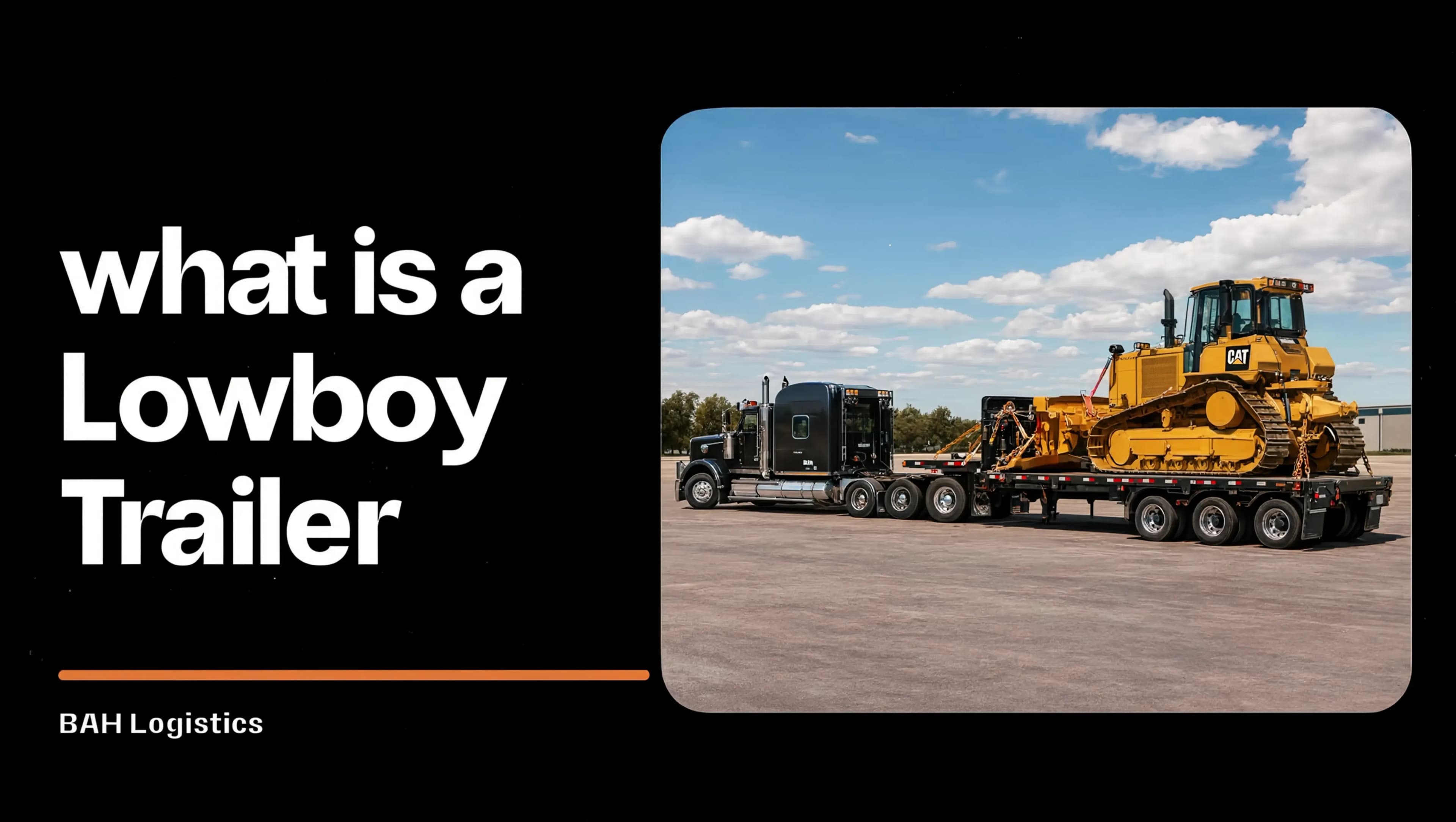

A lowboy trailer is a drop-deck semi-trailer designed to transport tall, heavy equipment that would exceed legal height limits on a standard flatbed trailer. If a load is too tall for a flatbed, a lowboy is often the best solution and sometimes the only way to keep your shipment within legal height limits.
That's why BAH Logistics customers regularly ask what a lowboy trailer is and when it should be used instead of a flatbed. Choosing the wrong trailer can lead to permit violations, safety concerns, costly delays, or a shipment that simply cannot be moved legally.
To avoid these issues, the BAH Logistics team carefully reviews the weight, dimensions, and deck height of every shipment to match the freight with the right equipment. Keep reading to learn how lowboy trailers work, the types of freight they're designed to haul, their common dimensions, and the key differences between lowboy trailer configurations.
What Is a Low Boy Trailer?
A lowboy trailer is an open-deck trailer built around two distinct drops in deck height; one drop occurs just after the gooseneck, and a second rise happens just before the rear wheels. That configuration places the main hauling deck roughly 18 to 24 inches off the ground, lower than any other standard trailer type.
The trailer goes by several names depending on region and industry: double drop, low-bed, low-loader, and float are all terms for the same equipment. Lowboy trailers are the most common in North America.
The low deck exists to solve a specific legal problem. In the United States, the standard maximum freight height is between 13 feet 6 inches and 14 feet. A standard flatbed deck sits approximately 5 feet off the ground, which leaves roughly 8 feet 6 inches of usable vertical space for cargo. A lowboy deck at 18 to 24 inches off the ground pushes that usable clearance closer to 11 feet 6 inches, nearly three additional feet of height before a load approaches the legal limit.
What Gets Hauled on a Lowboy Trailer
Lowboy trailers are built for freight that is too tall, too heavy, or too bulky for a standard flatbed or step deck. Based on what BAH Logistics carriers handle day to day, here's what typically moves on a low-boy trailer and why:
Extremely Tall Equipment
Lowboy trailers are the go-to solution for moving freight that exceeds the height capacity of both flatbeds and step decks. Manufacturing and energy industries rely on lowboys to transport large industrial machinery, transformers, and oversized pressure vessels. A 14-foot-tall industrial generator that would require extensive permitting on a step deck can move within legal limits on a lowboy, thanks to the deck sitting just 18 to 24 inches off the ground.
Construction Industry Applications
The construction sector depends on lowboy trailers for hauling the heaviest and tallest job site machinery. Excavators, bulldozers, large cranes, and tunnel boring equipment regularly move on lowboys. The ultra-low deck height accommodates the tall profiles of these machines and simplifies drive-on loading, particularly for tracked equipment that cannot be lifted by a forklift. Construction companies value lowboys for their ability to move oversized machinery in a single trip, reducing downtime between job sites.
Mining and Heavy Equipment Transport
Mining operations rely heavily on lowboy trailers to move equipment that no other standard trailer can legally handle. Haul trucks, drilling rigs, and large excavators common in mining environments frequently exceed 14 feet in height. The lowboy's low deck is often the only way to keep these loads within legal height limits without escalating to complex superload permitting and multi-axle rigging arrangements.
Agricultural Equipment Transport
Large agricultural businesses use lowboy trailers to move the tallest and heaviest farm equipment. Large combines, cotton pickers, and high-clearance sprayers often exceed what a step deck can accommodate. The lowboy's deck height gives these machines the vertical clearance they need, and the drive-on loading process simplifies transport during time-sensitive planting and harvest seasons.
Oversized Industrial and Energy Components
Energy and industrial sectors turn to lowboy trailers when components are too tall or too heavy for any other open-deck option. Large transformers, industrial boilers, reactor vessels, and wind turbine nacelles are regularly transported on lowboys. The combination of low deck height and high weight capacity makes the lowboy the preferred trailer for freight that sits at the outer edge of what highway transport can legally handle without a superload designation.
Oil and Gas Industry
The oil and gas sector is one of the heaviest users of lowboy trailers across all industries. Drilling rigs, blowout preventers, pump jacks, and refinery modules regularly exceed the height and weight thresholds of any other standard trailer type. Lowboys are often the best option for moving this equipment between drilling sites, refineries, and storage yards without triggering permits.
Bridge and Infrastructure Projects
Bridge and infrastructure contractors use lowboy trailers to transport large and heavy components needed for construction projects. These often include steel beams, bridge girders, precast concrete sections, and large drainage structures that are too tall or too heavy for standard flatbed or step deck trailers. Lowboy trailers make it possible to move these oversized components safely and legally from the fabrication yard to the job site.
Military and Government Equipment
Armored vehicles, tanks, self-propelled artillery, and other military machinery are among the heaviest and tallest loads regularly moved on public highways. Lowboy trailers are the standard equipment for military transport contractors handling this freight. The combination of low deck height and high weight capacity makes the lowboy the only standard trailer option that can accommodate most armored vehicles without escalating to specialized heavy-haul rigging.
Lowboy Trailer Dimensions and Weight Capacity
| Specification | Standard Dimension / Capacity |
|---|---|
| Deck Height | 18 inches to 24 inches |
| Well Length | 24 feet to 29 feet |
| Overall Length | 48 feet to 53 feet |
| Legal Width | 8 ft 6 in (102 inches) |
| Maximum Cargo Height (No Permit) | 11.5 feet to 12 feet (based on a 13.5- to 14-foot overall legal height limit) |
| Weight Capacity (2-Axle) | 35,000 lbs to 40,000 lbs |
| Weight Capacity (3-Axle) | 40,000 lbs to 55,000 lbs |
| Weight Capacity (4+ Axle / Jeep) | 55,000 lbs to 150,000+ lbs |
Exact legal weight and height limits vary by state regulations and specific travel routes. If your cargo dimensions or weight approach or exceed these standard limits, please review our comprehensive guide on oversize and overweight permit requirements to ensure regulatory compliance.
3 Types of Lowboy Trailers
At BAH Logistics, we regularly arrange shipments using all three main lowboy trailer types. The main differences come down to how your equipment is loaded, its height, and its length.
Fixed Neck Lowboy
A fixed-neck lowboy is the most common type, often used for hauling cargo such as heavy machinery and construction equipment. The gooseneck is permanently attached to the trailer, providing a stable and straightforward configuration for most standard heavy-haul applications. This option is favored for its simplicity and durability across a wide range of industries.

Fixed neck lowboys have stake pockets, tie-down rings, and outrigger pockets to secure a load during transit. Loading is typically done by crane or forklift from the sides or rear of the trailer.
Removable Gooseneck (RGN)
The removable gooseneck lowboy has a detachable front section that drops to the ground to form a drive-on ramp. This makes it the preferred option for loading tall and heavy equipment such as excavators, bulldozers, and industrial machinery that cannot be lifted by crane or forklift.

RGNs are the most versatile lowboy configuration available. The detachable design ensures quick loading and unloading, and a bulkhead can be attached to the front of the trailer to secure the load during transit.
Stretch Lowboy
A stretch lowboy is similar in design to a standard fixed-neck or RGN lowboy but features an extendable well section to accommodate longer loads. These trailers are the preferred option for cargo too long to fit onto a standard lowboy, such as large industrial vessels, long structural steel components, and wind turbine blades. Extended loads may still require a permit and escort vehicle, depending on overall length and the specific route traveled.

Whatever your hauling needs, work with a shipping company like BAH Logistics that has experience with all three lowboy trailer types. Choosing the right trailer from the start helps avoid delays, permit issues, and loading problems. Reach out to our team or get a free quote, and we'll pick the right trailer for your equipment. And you don’t have to decide which is the best for you. Call us or request an online quote, and our support team member will help you pick the right trailer for your heavy equipment.
Lowboy vs. Flatbed vs. Step Deck vs. RGN: Which One Do You Need?
| Trailer Type | Deck Height | Maximum Legal Cargo Height | Typical Payload Capacity | Primary Freight Profile |
|---|---|---|---|---|
| Flatbed | 60 inches | 8 feet 6 inches | 48,000 lbs | Palletized cargo, construction materials, steel coils, and side-loaded static freight |
| Step Deck | 38 to 42 inches | 10 feet | 48,000 lbs | Mid-height industrial machinery, tractors, and mixed loads requiring side-loading |
| Lowboy (FGN / RGN) | 18 to 24 inches | 11 feet 6 inches to 12 feet | 40,000 to 150,000+ lbs | Heavy oversized equipment, tall industrial machinery, and self-propelled or crane-loaded freight |
| Flatbed | 60 inches | 8 feet 6 inches | 48,000 lbs | Palletized cargo, construction materials, steel coils, and side-loaded static freight |
| Step Deck | 38 to 42 inches | 10 feet | 48,000 lbs | Mid-height industrial machinery, tractors, and mixed loads requiring side-loading |
| Lowboy (FGN / RGN) | 18 to 24 inches | 11 feet 6 inches to 12 feet | 40,000 to 150,000+ lbs | Heavy oversized equipment, tall industrial machinery, and self-propelled or crane-loaded freight |
Before requesting a quote from BAH Logistics, have all dimensions. Those figures determine which trailer type applies and whether permits will be required before the load can move.
How to Prepare Your Cargo for Lowboy Transport?
Proper preparation ensures safety, legal compliance, and a smooth transit. Here is how to prepare your cargo for transport:
Know Your Exact Dimensions
Accurate measurements prevent costly routing delays, permit denials, and safety hazards.
Measure carefully: Record the exact length, width, height, and weight of the cargo.
Include attachments: Measure with all buckets, booms, counterweights, or accessories attached.
Find the high point: Identify the absolute tallest peak of the load when sitting flat on the trailer deck.
Prepare the Machinery
Before the truck arrives, make sure the equipment is safe and ready to be loaded.
Clean the cargo: Wash off excessive mud, dirt, and debris. This ensures tie-down points are visible and prevents flying debris on the highway.
Drain fluids: Check for fluid leaks and reduce fuel levels to around a quarter tank to save weight.
Secure loose parts: Lock all doors, cover windows, and tightly secure or remove loose panels, hoses, or tools.
Fix the direction: Point exhaust pipes away from the direction of travel, or seal them completely to prevent wind damage to the turbocharger.
Check weight distribution: Identify the heaviest point of your load and communicate it to a shipping company in advance. On a lowboy, improper weight distribution over the axles can affect legal axle weight limits and require repositioning on pickup day, causing delays.
Clear the Loading and Unloading Area
Lowboy trailers and the trucks pulling them need plenty of space to load and unload safely, especially Removable Gooseneck (RGN) trailers.
Provide enough space: Make sure the loading area is flat, solid, and free of obstacles such as power lines or tree branches.
Check the ground: Avoid soft or muddy ground that could cause the trailer or equipment to sink.
Prepare the delivery site: The unloading area should meet the same requirements as the pickup location. Confirming both sites before transport helps prevent delays and unloading issues.
Arrange Permits and Escorts
If your shipment exceeds standard legal limits, you cannot move it without proper state authorization.
Check thresholds: Check local regulations, as shipments over 8.5 feet wide or 13.5 to 14 feet tall usually require oversize permits.
Book pilot cars: Extremely wide or tall loads will legally require escort vehicles (pilot cars) to clear the route ahead of the truck.
Plan the Tie-Down Strategy
While the carrier is responsible for securing the load under FMCSA cargo securement rules, you should ensure the cargo is physically capable of being tied down before the truck arrives.
Locate anchor points: Identify the designated D-rings or tying points on your machinery.
Check ratings: Ensure the anchor points are structurally sound and rated for the weight of the equipment.
Final Thought: Is a Low Boy Trailer Right for You?
Lowboy trailers open opportunities in construction, agriculture, oil and gas, and industrial freight markets that no other standard trailer can reach. At BAH Logistics, we work closely with customers across all of these industries and bring hands-on experience in lowboy transport.
As an FMCSA-registered and BBB-accredited vehicle shipping company, we have the equipment and expertise to match your load to the right trailer configuration, handle permit coordination, and plan routes across all 50 states.
If you are ready to move your equipment, request a quote today, and a member of our team will help you determine the right trailer, confirm your dimensions, and get your shipment on the road.
Frequently Asked Questions
How far in advance should I book?
Standard lowboy bookings typically require three to five business days of lead time. During peak construction and infrastructure seasons, booking two weeks or more in advance is advisable to secure the right equipment and avoid scheduling delays.
How much does it cost to ship equipment on a lowboy trailer?
The cost of shipping equipment on a lowboy trailer depends on the distance, the size and weight of the equipment, the type of lowboy trailer required, and whether permits or escort vehicles are needed. Because lowboy trailers are designed for oversized and heavy loads, shipping usually costs more than standard flatbed or step deck transport.
Why do carriers charge more for an RGN than a standard lowboy?
RGN trailers have a higher tare weight, specialized hydraulic components, and require manual labor to detach and reattach the gooseneck. This increased operational complexity and fuel consumption translate to a premium equipment fee.
Do lowboy trailers require oversize permits for width?
Yes, if the cargo width exceeds 8 feet, 6 inches (102 inches). Standard lowboy trailers match this maximum legal width, so any freight extending past the trailer sides requires state-level oversize permits and "Oversize Load" flagging.




