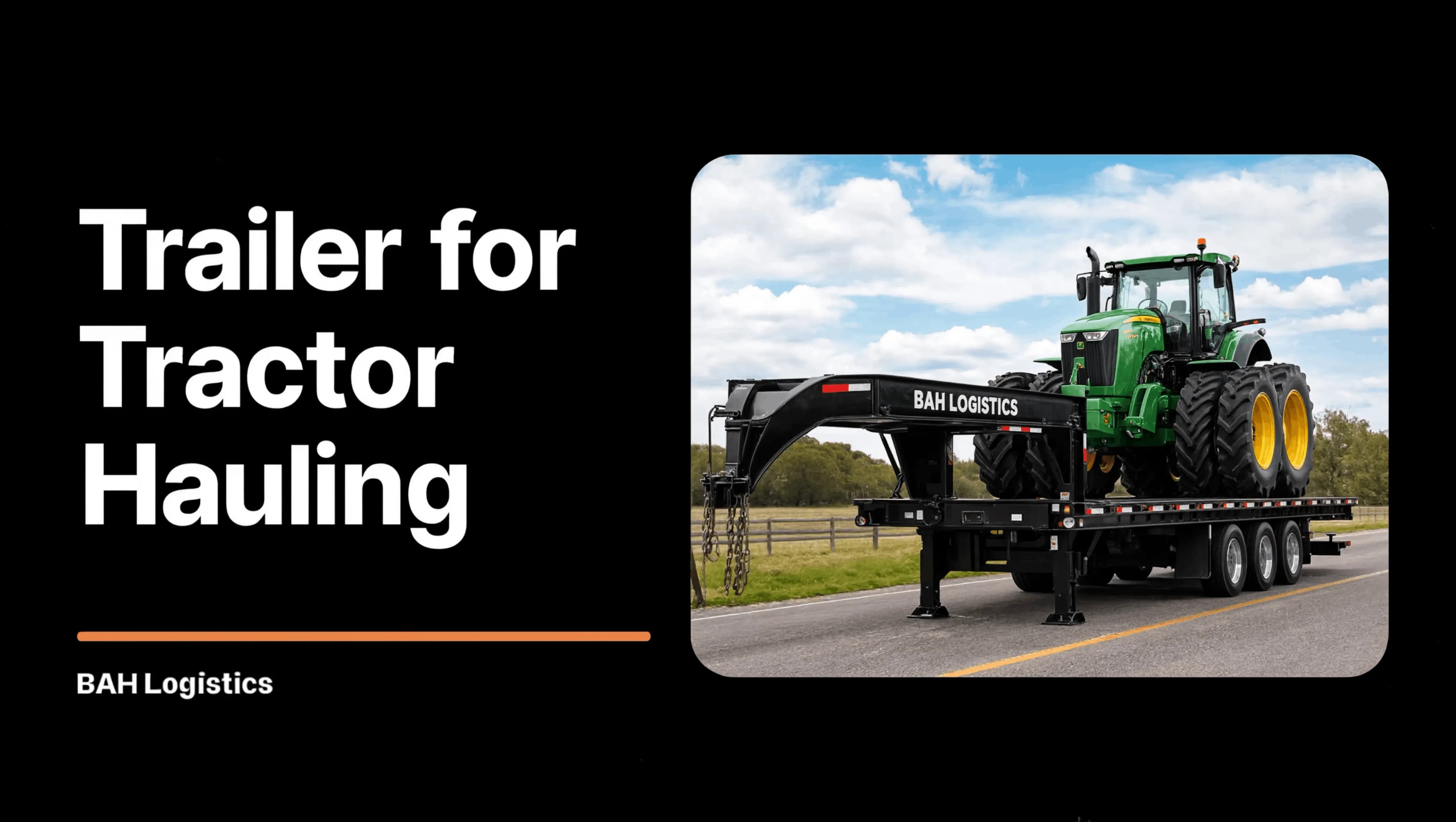

Hauling a tractor is not as simple as backing up a trailer and loading it up. The wrong trailer choice can result in permit violations, loading failures, equipment damage, or a shipment that gets turned back at a weigh station. With tractor sizes ranging from a 20 HP garden unit to a 400 HP articulated 4WD machine, there is no single trailer that fits every situation.
At BAH Logistics, we work with the full range of these trailer types daily to move farm equipment and heavy machinery across the country. This guide covers the six trailer types we use for tractor transport, what each one is built for, and the key factors that determine which one your shipment actually needs.
6 Trailers for Tractor Hauling
The right trailer depends on three key factors: your tractor's weight, its height, and whether it can be driven onto the trailer or needs to be lifted. Here are the most common trailer types used for tractor hauling:
Equipment Trailers (Bumper Pull / Flatbed)
If you're hauling a compact utility, sub-compact, or garden tractor, an equipment trailer is often the simplest and most affordable option. These trailers are widely available for rent or purchase, making them a popular choice for short to medium-distance transport on paved roads.
Best For: Compact utility, sub-compact, and garden tractors
Payload Capacity: Typically 7,000- 16,000 lbs, depending on trailer size and axle configuration
Tow Vehicle: Standard 3/4-ton or 1-ton pickup truck
Deck Profile: Flat deck with standard bumper-pull configuration
A CDL is required when the combined GVWR of your tow vehicle and trailer exceeds 26,001 lbs. A separate CDL trigger also applies when towing a vehicle with a GVWR over 10,001 lbs if the combined total exceeds 26,001 lbs. These are independent thresholds, not conditions that must be met simultaneously. Always verify federal and state regulations, including any applicable farm exemptions.
Gooseneck Trailers
As tractor size and weight increase, a gooseneck trailer offers improved stability and load control. These trailers connect to a hitch mounted in the bed of a pickup truck directly above the rear axle, providing better weight distribution than a standard bumper-pull trailer.
Best For: Mid-size agricultural and farm tractors, typically 40–150 HP
Payload Capacity: Typically 25,000–30,000 lbs, depending on axle configuration
Tow Vehicle: 1-ton or larger pickup truck with a bed-mounted gooseneck hitch
Deck Profile: Flat deck, typically 20–40 feet long with loading ramps
Important to remember: Gooseneck trailers require a dedicated bed-mounted hitch and cannot be connected to a standard rear receiver hitch.
Step Deck Trailers (Single Drop)
A step deck trailer may be the ideal solution for transporting a tractor with a cab. Its lowered main deck provides additional vertical clearance, helping many tractors remain within legal highway height limits.
Best For: Mid-to-large agricultural tractors with factory-installed cabs
Payload Capacity: Up to 48,000 lbs
Tow Vehicle: Commercial semi-tractor (Class 8 truck)
Deck Profile: Single-drop deck, typically 34–36 inches above the ground
Important to remember: The lower deck height improves clearance for tall equipment but can increase the risk of bottoming out on steep railroad crossings, driveways, or uneven terrain.
Lowboy Trailers (Double Drop)
For large tractors, combines, and heavy agricultural equipment that exceed standard trailer height limitations, a lowboy trailer is often the preferred choice. Its extremely low center deck allows tall equipment to remain compliant with highway height restrictions while improving overall load stability.
Best For: Large agricultural tractors, combines, and heavy equipment
Payload Capacity: Up to 80,000 lbs or more with additional axle configurations
Tow Vehicle: Heavy-duty commercial semi-tractor
Deck Profile: Double-drop deck, typically 18–24 inches above the ground
Important to remember: The low deck height requires careful route planning to avoid steep grades, uneven surfaces, and low-clearance obstacles.
RGN (Removable Gooseneck) Trailers
When transporting the largest agricultural and industrial equipment, RGN trailers are considered the gold standard. The removable front gooseneck detaches completely, allowing equipment to be driven directly onto the trailer deck from ground level.
Best For: Large 4WD articulated tractors, combines, and heavy industrial machinery
Payload Capacity: Up to 150,000 lbs or more with multi-axle configurations
Tow Vehicle: Heavy-duty commercial semi-tractor or multi-axle heavy-haul rig
Deck Profile: Front-detaching double-drop deck with optional extendable configurations
Important to Remember: RGN trailers are commonly used for loads that exceed standard legal dimensions and may require oversize permits, pilot cars, route surveys, or other specialized transportation requirements.
Deckover Flatbed Trailers
If your tractor or implement is too wide for a standard equipment trailer, a deckover flatbed may be the best solution. Unlike conventional trailers, where the deck sits between the wheels, a deckover places the deck above the tires, providing the full trailer width for loading wide equipment.
Best For: Wide tractors, agricultural implements, and oversized equipment
Payload Capacity: Typically 10,000–30,000 lbs, depending on trailer size and axle configuration
Tow Vehicle: 3/4-ton or 1-ton pickup truck, depending on load weight
Deck Profile: Full-width deck positioned above the trailer wheels
Important to remember: Because the deck sits higher off the ground than a standard equipment trailer, loading angles are steeper and the load's center of gravity is higher during transport. Proper load securement and cautious driving are essential.
How to Choose the Right Trailer for Your Tractor Shipment?
You don't have to be an expert, but knowing these 5 things before you call a shipping company will save you time, money, and headaches.
Consider Your Tractor's Weight and Dimensions
Before you contact a shipping company, pull the Gross Vehicle Weight (GVW) from your tractor's manufacturer's spec sheet. Then measure the height, width, and length, especially if attachments or implements are coming along. The more accurate your numbers, the faster and more accurately your carrier can quote you and book the right trailer.
Ask About Payload Capacity and the Safety Buffer
A good shipping company will never load a trailer at 100% of its rated capacity. Ask the company what safety buffer they apply; the industry standard is 10–20%. If a company isn't accounting for this, that's a red flag. Your equipment's safety depends on it.
Mention the Route Type and Distance
The road matters as much as the load. Let the heavy equipment shipping company know whether this is a short farm-to-farm move or a long-distance highway shipment, and whether any part of the route is off-road or rural. This determines which trailer type is appropriate, what axle ratings are needed, and whether ground clearance could be an issue.
Specify if the Tractor Is Driveable
This is one of the most important details the carrier needs to know upfront. If the tractor runs and can be driven up ramps, standard equipment trailers, or goosenecks work perfectly. If the machine is non-operational, oversized, or simply too heavy to drive up a ramp safely, the shipping company will need to arrange an RGN trailer, where the gooseneck detaches, and the tractor drives directly onto the deck at ground level.
Quick Reference: Tractor Trailer Types
Now that you know the details, here's a quick summary to help you compare all trailer types side by side at a glance.
| Trailer Type | Best For | Typical Capacity |
|---|---|---|
| Equipment Trailer | Compact utility, sub-compact, and garden tractors | 7,000–16,000 lbs |
| Gooseneck Trailer | Mid-size farm tractors (40–150 HP) | 25,000–40,000 lbs |
| Deckover Flatbed | Wide tractors and agricultural implements | 10,000–30,000 lbs |
| Step Deck Trailer | Tall tractors with cabs | Up to 48,000 lbs |
| Lowboy Trailer | Large tractors, combines, and heavy equipment | Up to 80,000 lbs |
| RGN Trailer | Articulated tractors and oversized machinery | Up to 150,000+ lbs |
Let the Company Handle the Permits, but Know the Basics
A professional shipping company will manage all permit requirements for you. Loads exceeding 8.5 ft in width or 80,000 lbs gross vehicle weight typically require oversize or overweight permits, which vary by state. It is equally important to note that federal axle weight limits, 20,000 lbs on a single axle and 34,000 lbs on a tandem axle, can trigger permit requirements even when the total gross weight is below 80,000 lbs. How weight is distributed across axles matters as much as total load weight.




